
Organisational Culture

Why is it important to develop culture intentionally?

Culture develops spontaneously over time, shaped by the patterns that emerge and consolidate, creating a collective identity. This identity is forged primarily by the behaviour of leaders, but it is reinforced by many other elements and is continually influenced by all the people within the organisation.

A culture that develops unintentionally often drifts away from the one represented by the organisation’s declared values. Behavioural patterns that become established over time may reveal entirely different values, depending on what is encouraged, rewarded or prioritised in day-to-day decisions. These gaps between what is stated and what is practised frequently nurture toxic environments.

On the other hand, when culture is developed intentionally, by consistently cultivating the desired values, it helps attracting people who identify with the organisation’s values and purpose. This alignment strengthens commitment, cohesion and collaboration, and consequently enhances financial results.

A well-developed organisational culture may become a major competitive advantage: products, services, processes and technologies can be easily copied, but culture is complex and unique. It cannot be replicated.

To navigate increasingly complex and unpredictable environments, organisations need cultures that are simultaneously: strong, to generate a sense of belonging and uniting people through shared values and purpose; and flexible, to keep open to adapt to changes in direction and continuously evolve in harmony with strategy.

Developing culture intentionally is no longer optional; it is essential. It is a fundamental responsibility of leadership: creating the context that enables strategy to be executed effectively.

"The only thing of real importance that leaders do is create and manage culture. If you do not manage your culture, it manages you - and you may not even be aware of the extent to which this is happening."
(Edgar H. Schein)

How to develop culture intentionally

To intentionally develop culture in a way that aligns with strategy, the first step is to understand the existing culture. I strongly recommend conducting a Cultural Assessment using the tools from Barrett Values Centre®.

A Cultural Assessment serves as the starting point, enabling the organisation to map the current and the desired culture from the perspective of those who live the organisation’s reality. This map highlights gaps and opportunities for improvement, serving as a basis for defining the values that should be cultivated to create the most favorable conditions for achieving the desired results.

Once the organisation has defined its aspirational values, communicating them is not enough. These values must be perceived in leaders’ behaviour and reflected across all elements that express the organisational culture: communication, physical space, policies and rules, processes, rituals, and the dynamics of interpersonal interactions.

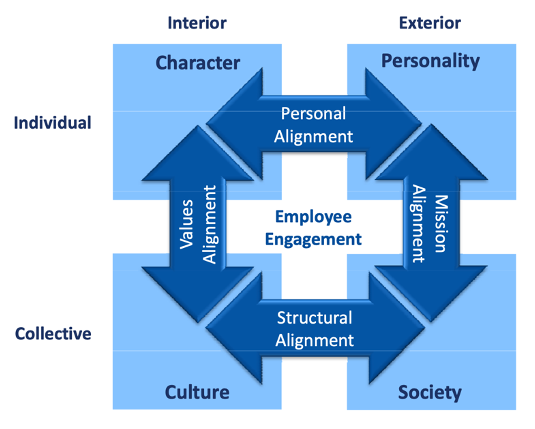
The journey of cultural development or transformation involves multiple stages. In his book The Values-Driven Organisation, Richard Barrett illustrates, using Ken Wilber’s four-quadrant model, how cultural change unfolds from a systemic perspective:

According to this model, cultural transformation requires both individual and collective alignment, across inner and outer dimensions. In other words:

  • Personal alignment between what one believes (values) and what one does (behaviour);
  • Structural alignment between declared values and the organisation’s reality (structure, policies, processes, incentives, etc.);
  • Personal and Organisational Values alignment;
  • Mission alignment, connecting employees’ sense of purpose with their role within the organisation.

Organisational Culture Assessments

Cultural Assessments developed by Barrett Values Centre® are recognised worldwide and have supported thousands of organisations in strengthening their cultures over the last 25 years. Barrett Analytics™ offers a scalable methodology, which is customisable and is available in more than 60 languages, with several assessment options tailored to each organisation’s profile and needs.

All assessment tools are based on the Barrett Model®, created by Richard Barrett. Inspired by Abraham Maslow’s Hierarchy of Needs and refined through more than two decades of practical application, the model identifies seven fundamental areas that represent human needs and motivations.

The Barrett Model

The Barrett Model® provides a powerful framework for understanding personal and organisational values, how they interact and shape culture, levels of cultural entropy, areas of alignment and opportunities for individual and organisational development.

There are four principles, or “mantras”, that form the phylosophical foundations of the Barrett Values Centre® methodology:

  1. Cultural capital is the new frontier of competitive advantage – products and services can be copied; culture cannot.
  2. Organisations do not transform itself – people do.
  3. Organisational transformation begins with the cultural transformation of leaders.
  4. Measurement matters – it provides indicators and set the path forward for management.

As a certified consultant, I use this methodology to help organisations understand what drives people to deliver their best, identify tensions or patterns that may be limiting collective potential, and align culture with purpose and strategy.


Expected Outcomes

Our cultural diagnostics are tailored to each organisation’s context and needs. They reveal, clearly and comprehensively, how the current culture is perceived and what people aspire to for the future, offering an indicator of the culture’s strenght, its entropy level, and the potential paths for evolution. Those results come from the organisation’s collective intelligence, highlighting real strengths, patterns and challenges.

The reports also provide demographic and functional data that uncover differences in perception across departments, leadership levels or regions – essential insights for identifying blind spots and informing strategic decisions. The methodology includes optional modules such as comparative reports, thematic analyses of values and additional layers of investigation.

To track changes over time, organisations may use the Cultural Transformation Report, which monitors cultural evolution across successive cycles. The model also includes specific applications for contexts such as mergers and acquisitions, educational institutions, public organisations, communities and customer experience – always with the aim of generating clarity, alignment and sustainable development.

When combined with Leadership Assessments, Cultural Assessment offer a deep and systemic view of the organisation through the lens of its people, creating the foundations for a human-centred management approach, since culture is one of the most important pillars of wellbeing.

In an environment of uncertainty and volatility, a more human and sustainable business model becomes a significant competitive advantage. Recent research consistently highlights a strong correlation between wellbeing, engagement levels and financial results.

Would you like to know more?

If you want more information about the Barrett Model® and how it is applied in culture assessments, you can watch the video Discover What Truly Matters.

And if you want more details on the different types of culture assessments available, click here: Culture Assessments .

Barrett Analytics offers several assessment options, adaptable to the unique needs of each organisation. Prices vary according to the type of assessment, the number of people assessed, and specific needs that require customization, such as demographic cuts for detailed analysis of results, among others.

If you wish, we can schedule a preliminary, no-obligation conversation to understand your organisation’s needs and prepare an appropriate proposal.

Let’s talk!